

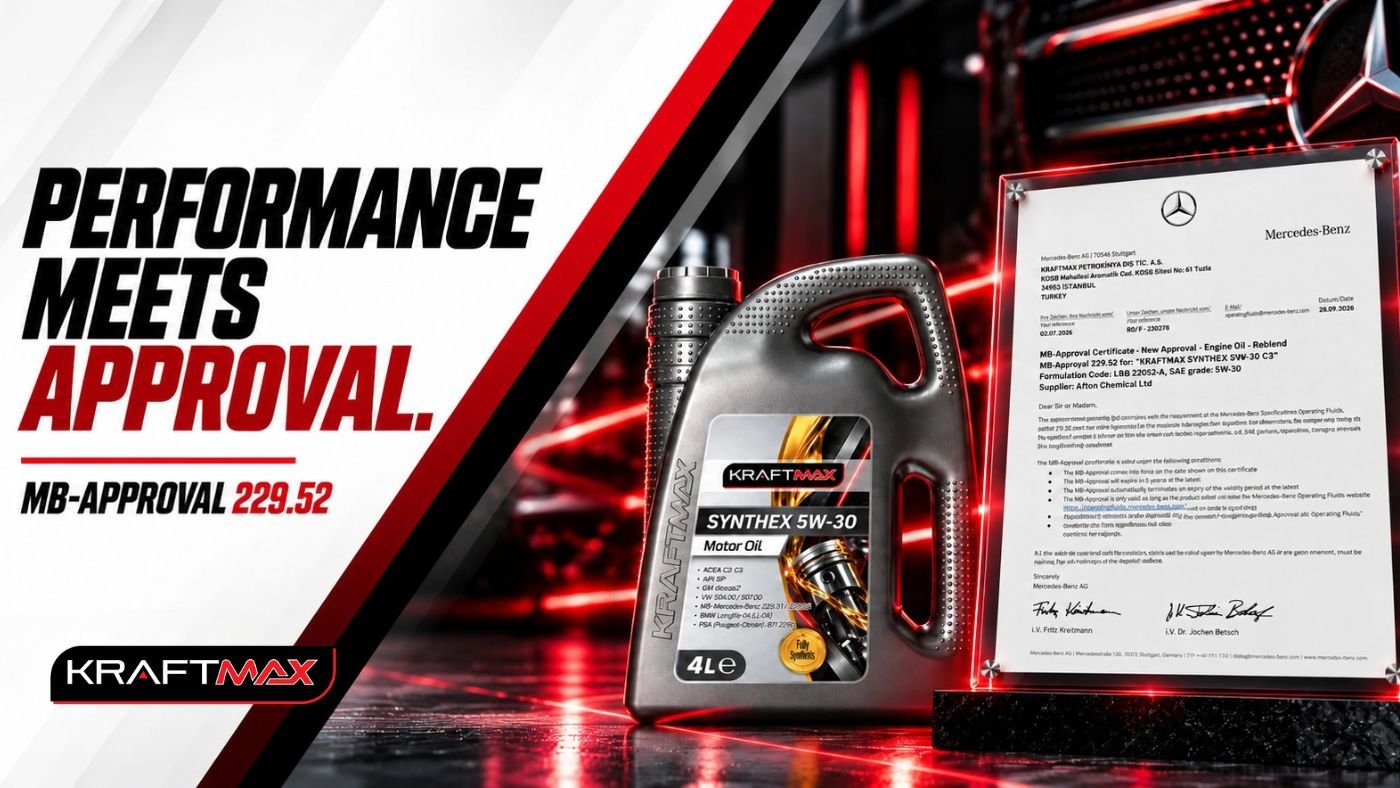
PERFORMANCE MEETS APPROVAL.
Our KRAFTMAX SYNTHEX 5W-30 C3 has received MB-Approval 229.52 from Mercedes-Benz, adding an official manufacturer approval to our passenger car portfolio.
For distributors sourcing an MB 229.52 approved engine oil, this means a specific KRAFTMAX product supported by an approval certificate and technical documentation.
Contents
- Meet the SYNTHEX 5W-30
- Viscosity, Performance Categories and Approvals
- What This Approval Brings to Our Distributors
- Build Your KRAFTMAX Assortment Around Your Market
- Bring Approved Performance to Your Market
- Frequently Asked Questions
1. Meet the SYNTHEX 5W-30
Our KRAFTMAX SYNTHEX 5W-30 C3 belongs to the SYNTHEX fully synthetic engine oil series, developed for modern gasoline and diesel engines, including applications equipped with Diesel Particulate Filters (DPF) and Three-Way Catalysts (TWC).
Formulated with Low SAPS technology, it combines engine protection with compatibility with modern exhaust aftertreatment systems. Its performance characteristics support wear protection, thermal stability and engine cleanliness, alongside low-temperature performance and fuel efficiency.
For distributors, these characteristics address everyday service priorities: protecting engine components, managing operating temperatures and selecting a lubricant suited to the vehicle’s emissions-control equipment. Oil change intervals must follow the vehicle manufacturer’s instructions.
With MB-Approval 229.52, SYNTHEX 5W-30 C3 now brings an official Mercedes-Benz approval to this product profile, giving our partners an MB 229.52 approved engine oil to consider where the vehicle’s specification and viscosity requirements match.
2. What Does MB-Approval 229.52 Mean?
Mercedes-Benz classifies specification 229.52 within its Low SPAsh multigrade service engine oil category.
Low SPAsh refers to controlled levels of sulfated ash, phosphorus and sulfur. These characteristics are relevant to lubricant selection for engines equipped with exhaust aftertreatment systems. MB-Approval 229.52 identifies a formal Mercedes-Benz approval for the named product.
Mercedes-Benz provides official operating fluids information for specification 229.52 and refers users to sheet 223.2 for vehicle and engine applicability. Buyers should check these requirements alongside the vehicle’s service instructions.
3. Viscosity, Performance Categories and Approvals
A workshop asking for “5W-30 engine oil” has supplied one part of the information needed for product selection.
The SAE viscosity grade describes viscosity characteristics under defined conditions. Industry performance categories, such as ACEA categories, describe another set of requirements. Manufacturer approvals identify credentials under a vehicle manufacturer’s specification.
These details work together:
|
Information |
What it tells the buyer |
|
SAE viscosity grade |
The oil’s viscosity classification |
|
Industry performance category |
The stated industry performance requirements |
|
Manufacturer approval |
The manufacturer specification under which the product is approved |
For KRAFTMAX SYNTHEX 5W-30 C3, our partners can identify SAE 5W-30 viscosity and MB-Approval 229.52 together. The next step is matching those credentials to the customer’s vehicle requirements.
4. What This Approval Brings to Our Distributors
When customers ask what sets your engine oil range apart, an official manufacturer approval gives you something concrete to show them. With KRAFTMAX SYNTHEX 5W-30 C3, you can bring together our bold brand identity, fully synthetic Low SAPS formulation and MB-Approval 229.52 from Mercedes-Benz.
For distributors serving the Mercedes-Benz aftermarket, this creates an opportunity to connect with workshops and retailers looking for an MB 229.52 approved engine oil. It gives SYNTHEX a clear place in your offer for applications requiring this specification and viscosity.
Make the approval part of your product launch, sales presentations and customer conversations. Pair the SYNTHEX bottle with its approval certificate, and give your sales team the technical information to answer the next question.
Put approved performance at the centre of your next KRAFTMAX offer, and give customers a product story backed by proof.
5. Build Your KRAFTMAX Assortment Around Your Market
Different vehicles. Different demands. More reasons to choose KRAFTMAX!
MB-Approval 229.52 is part of a wider story. Across our portfolio, selected KRAFTMAX products also carry API licensing and Volvo OEM approvals, giving distributors additional credentials to present to customers across passenger car and heavy-duty applications, and more.
For partners supplying both automotive workshops and commercial vehicle customers, this breadth opens opportunities beyond a single product category. Explore our range with our export team and request the products specific relevant to your market.
6. Bring Approved Performance to Your Market
Let’s Grow Your Business with KRAFTMAX.
With a wide lubricant portfolio, API licensing and OEM approvals across selected products, we offer more ways to meet your customers’ needs. Our experience working with partners across every continent brings market knowledge to the conversation, from product selection to building a range suited to local demand.
Contact our export team to discuss your market, explore our portfolio and discover what we can build together.
Frequently Asked Questions
What is an MB 229.52 approved engine oil?
It is an engine oil that has received Mercedes-Benz approval under specification 229.52. Suitability also depends on the vehicle’s prescribed oil specification, permitted viscosity and service instructions.
Which KRAFTMAX product has MB-Approval 229.52?
KRAFTMAX SYNTHEX 5W-30 C3 has received MB-Approval 229.52 from Mercedes-Benz. Our export team can provide the approval certificate and supporting product documents for distributors and importers evaluating it.
Is every 5W-30 engine oil suitable for the same vehicles?
No. Two 5W-30 oils can have different industry performance categories and manufacturer approvals. Compare the full specifications with the vehicle’s requirements rather than selecting an oil from the viscosity grade alone.